Hospital Teams Showcase Skill and Collaboration in Emergency Preparedness Drill
by Raiili Pellizzari
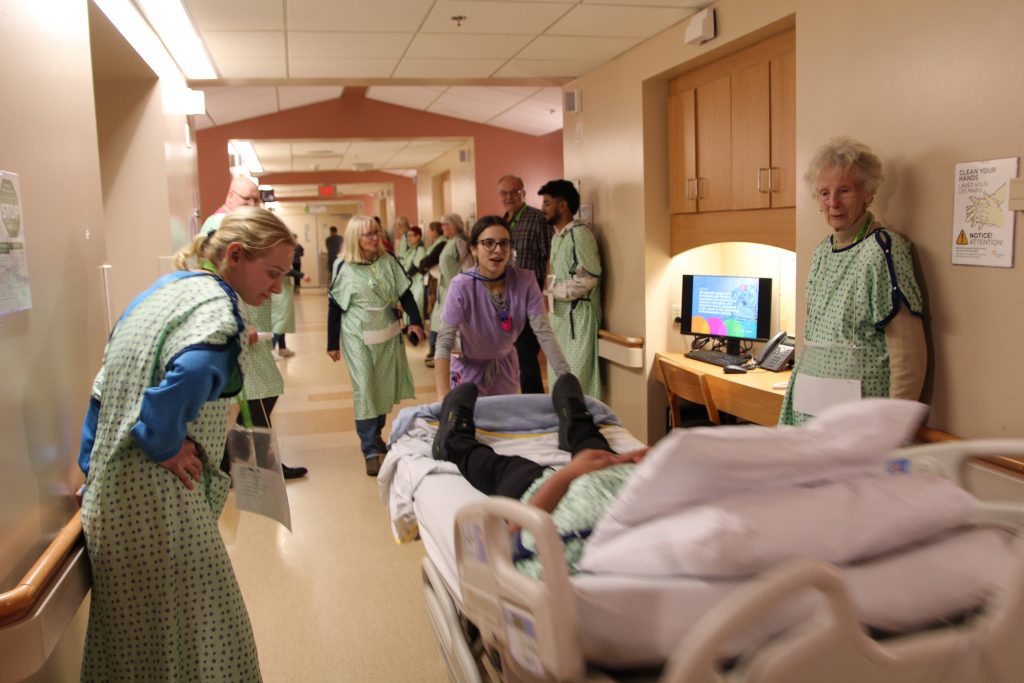 During the drill, more than 40 volunteers acting as mock patients and family members were evacuated from 3B (Surgical Inpatient) to 3C.
Teamwork, dedication, and excellence were on full display during Thunder Bay Regional Health Science Centre (TBRHSC)’s recent Minimum Staffing Drill. This annual exercise, mandated by the Ontario Fire Code, is coordinated by TBRHSC’s Emergency Preparedness and Interprofessional Education teams, and in partnership with Thunder Bay Fire Rescue (TBFR).
The Hospital-wide drill tests the ability to safely evacuate an in-patient unit during hours with minimum staffing levels. Every year the drill focuses on a different area of the Hospital to enhance these capabilities.
During the drill, more than 40 volunteers acting as mock patients and family members were evacuated from 3B (Surgical Inpatient) to 3C. This enhanced the exercise by providing the opportunity for staff to practice communication techniques and apply patient and family centred principles.
Volunteer Barb Rickards was happy to join in the learning opportunity for staff. “I had so much fun being a mock patient family member,” she exclaimed. “It was interesting to see what happens behind the scenes during a Hospital drill and how everyone stays calm and focused. The drill gave me a real appreciation for how much coordination and teamwork goes into providing safe patient care. It was great to see how the team worked together under pressure.”
The “room of origin” (where the mock fire started) was evacuated within 36 seconds and the entire unit was evacuated in 16 minutes and 44 seconds. Teams demonstrated strong communication and problem-solving skills while maintaining patient care standards. The exercise also provided valuable insight into workflow efficiency, communication processes, and cross-departmental support. Additionally, TBFR was impressed with how clean Anne Purves, Manager 3B, and her staff kept the unit, with tidy sprinkler heads and properly stored equipment.
“This was the first year we’ve had evacuation door tag markers in place, which will help accelerate the process for searching rooms and identifying them as evacuated,” said Mēsha Richard, Emergency Preparedness Lead. “Staff did an amazing job utilizing the new tool, but more familiarity will be beneficial. Everyone needs to trust that if a door is marked it means that space was already searched and cleared.”
“Overall, this drill gave us a realistic picture of how we can continue to deliver excellent care even under challenging circumstances,” added Richard.
The drill concluded successfully, with lessons learned documented and action plans developed to enhance exercise realism and improve future response strategies. Key takeaways included the importance of clear communication and delegation, as well as wayfinding to ensure responders follow the safest routes in and out of the impacted unit.